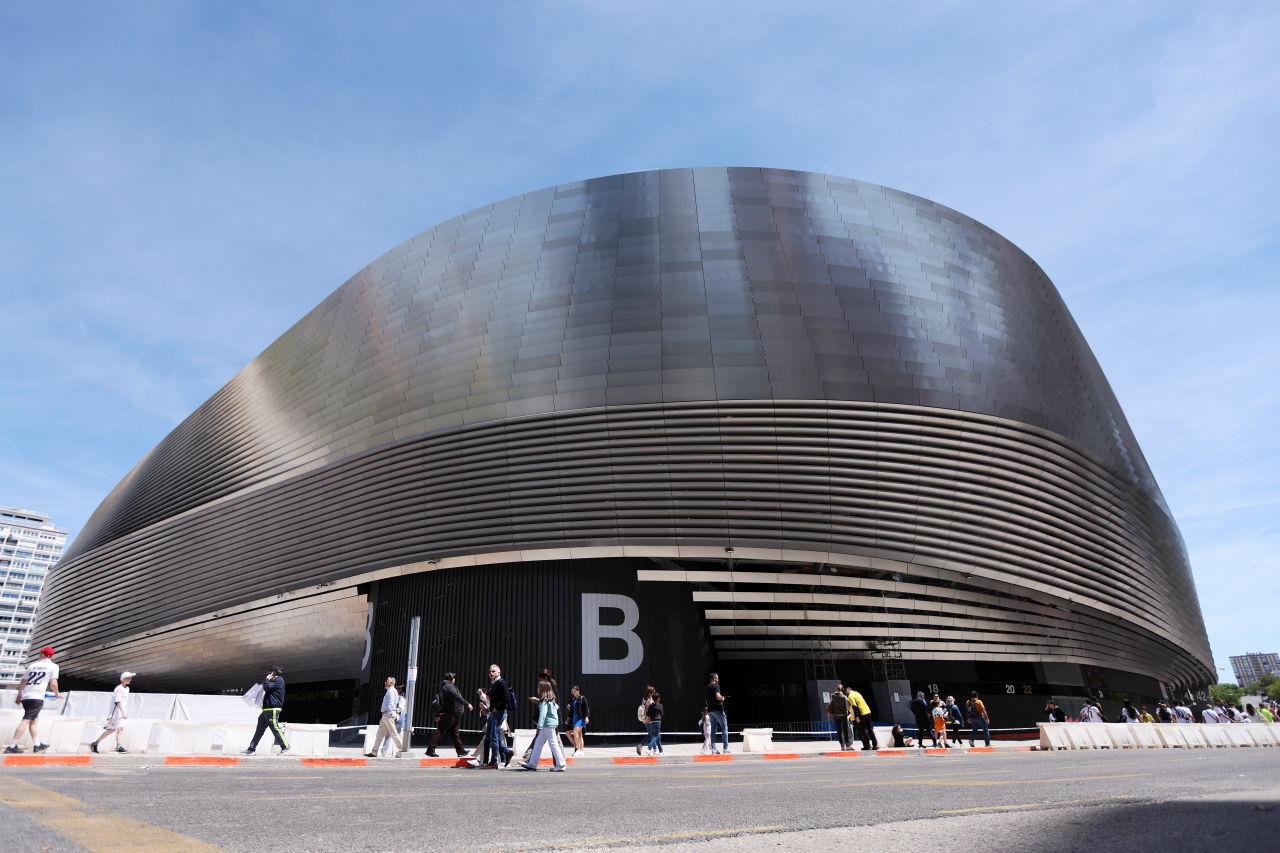
On June 5, 2026, Spanish newspaper El Mundo published an article with a striking headline: “The debt accumulated through the Bernabéu redevelopment puts Real Madrid’s future at risk.”
The article examines the impact of the Santiago Bernabéu redevelopment on the club’s financial position and raises questions about the long-term sustainability of the project.
Original source:
https://www.elmundo.es/economia/empresas/2026/06/05/6a22aa21e4d4d8e90b8b45a7.html
It is a bold claim.
If true, it would mean that the largest investment in Real Madrid’s history has significantly weakened the club’s financial position.
But what do the club’s accounts actually tell us?
Executive Summary
Real Madrid’s financial statements reveal a complex reality that does not fully align with either the optimism of its supporters or the alarmism of some headlines.
Over the past few years, the redevelopment of the Santiago Bernabéu has fundamentally transformed the club’s financial structure.
| Indicator (€m) | 2020 | 2021 | 2022 | 2023 | 2024 | 2025 |
|---|---|---|---|---|---|---|
| Total Assets | 1,434 | 1,585 | 2,269 | 2,318 | 2,684 | 2,839 |
| Equity | 533 | 534 | 546 | 558 | 574 | 598 |
| Bernabéu Debt | - | - | 887 | 963 | 1,241 | 1,282 |
| Cash Position | - | - | 773 | 253 | 208 | 176 |
The club’s total assets have nearly doubled since 2020, reflecting the scale of the investment made in the new stadium.
However, this growth has not been matched by a comparable increase in equity. Most of the difference has been financed through external borrowing linked to the Bernabéu project.
At the same time, available liquidity has declined significantly, while stadium-related debt now exceeds €1.28 billion.
The key question is not whether Real Madrid generates sufficient revenue today.
It does.
The real question is whether the new Bernabéu will be able to transform that massive investment into recurring cash generation over the coming decades.
The Business Has Never Been Stronger
One of the most interesting conclusions of the analysis is that Real Madrid’s challenge does not appear to lie in its ability to generate revenue.
| Year | Operating Revenue |
|---|---|
| 2022 | €722m |
| 2023 | €843m |
| 2024 | €1,073m |
| 2025 | €1,185m |
Revenue has increased by more than 64% since 2022.
For the first time in its history, the club has surpassed €1 billion in annual revenue and continues to show a clear upward trend.
Far from deteriorating, the business appears stronger than ever.
Profitability Is Also Improving
EBITDA trends reinforce this conclusion.
| Year | EBITDA |
|---|---|
| 2022 | €203m |
| 2023 | €158m |
| 2024 | €156m |
| 2025 | €243m |
After two relatively stable years, operating profitability surged to €243 million in 2025.
This suggests that the new revenue streams associated with the stadium are beginning to flow through to the income statement.
The Cost of Transformation
The other side of the story is debt.
| Year | Bernabéu-Related Debt |
|---|---|
| 2022 | €887m |
| 2023 | €963m |
| 2024 | €1,241m |
| 2025 | €1,282m |
The redevelopment of the stadium has required extraordinary financing.
Debt directly linked to the Bernabéu project now exceeds €1.28 billion.
At first glance, the figure is striking.
However, debt itself is not necessarily a problem.
The relevant question is whether the asset being financed will be capable of generating sufficient cash flow to repay that debt without compromising the club’s broader operations.
The Warning Sign Lies in Liquidity
If there is one figure that deserves close attention, it is the evolution of the club’s cash position.
| Year | Cash Position |
|---|---|
| 2022 | €773m |
| 2023 | €253m |
| 2024 | €208m |
| 2025 | €176m |
Available cash has fallen by approximately 77% since 2022.
Part of this decline is perfectly understandable.
Funds raised through borrowing have been used to finance the stadium redevelopment.
Even so, the difference compared to the club’s previous financial position is significant.
Real Madrid remains highly profitable, but it now operates with far less financial flexibility than it did just a few years ago.
Working Capital Tells a Different Story
The evolution of working capital reinforces this view.
| Year | Working Capital |
|---|---|
| 2022 | +€355m |
| 2023 | -€145m |
| 2024 | -€188m |
| 2025 | -€357m |
Negative working capital does not automatically imply insolvency.
Many major football clubs operate under similar conditions due to advance payments from members, sponsors, and commercial partners.
However, the deterioration observed over the last few years suggests a considerably more stretched financial structure than the one that existed before the stadium redevelopment.
The Bernabéu’s Annual Cost
Now that construction has largely been completed, the stadium is no longer simply an investment. It has become a recurring cost.
| Item | Annual Impact (2025) |
|---|---|
| Depreciation | €35m |
| Financial Expenses | €37m |
| Total | €72m |
The Bernabéu project currently generates approximately €72 million per year in depreciation and financing costs.
To justify the investment economically, the stadium must generate value in excess of that figure.
This will be one of the key indicators to monitor in the years ahead.
Concerts Are Not the Core of the Business
For months, much of the public debate has focused on concerts.
However, the numbers suggest a different reality.
According to the estimates reviewed, concerts and extraordinary events account for roughly 1% of the club’s annual revenue.
The stadium’s true economic potential appears to lie elsewhere:
- VIP boxes
- Premium hospitality
- Food and beverage operations
- Corporate events
- Permanent commercial activities
- New business opportunities linked to the venue
Concerts may contribute to profitability, but they are unlikely to determine the overall success or failure of the project.
The Question Raised by the Accounts
The club’s current leadership has proposed the possibility of selling between 5% and 10% of a future business subsidiary linked to the stadium and its commercial operations.
The available financial statements do not allow us to conclude that such a transaction is motivated by liquidity concerns.
However, they do allow us to ask a reasonable question.
The proposal comes after:
- An investment exceeding €1.3 billion.
- A 77% decline in available cash.
- Negative working capital of €357 million.
- More than €1.28 billion in stadium-related debt.
If the business is generating record revenues and the Bernabéu is expected to become the club’s main economic engine, why is there now a need to bring in external capital?
It is a legitimate question that is likely to remain part of the debate for years to come.
Behind the Headline
The headline is that Real Madrid has accumulated more than €1.28 billion in debt associated with the redevelopment of the Santiago Bernabéu.
But behind the headline lies a more complex reality.
The club’s accounts do not show an organisation struggling operationally. Quite the opposite. Revenue and profitability are at record levels.
The real issue is liquidity.
Available cash has fallen significantly, working capital has deteriorated, and the investment now needs to prove that it can generate recurring cash flow.
For that reason, the debate should not focus solely on the size of the debt.
The more relevant question is whether the new Bernabéu will be capable of generating enough cash to justify an investment exceeding €1.3 billion while gradually restoring the financial strength that has historically characterised the club.
In this context, another question naturally emerges.
The club’s leadership has expressed its intention to explore the sale of a minority stake in part of the business. The available accounts do not allow us to conclude that such a move is driven by liquidity needs, but neither do they allow us to dismiss the possibility that the two issues may be related.
When a proposal of this nature emerges following a significant decline in available cash, negative working capital, and an investment largely financed through debt, it is reasonable for supporters and analysts alike to wonder whether the objective is purely value creation or whether it also aims to strengthen a financial structure that is now more demanding than it was before the stadium redevelopment.
There is no definitive answer.
What the numbers do suggest, however, is that the long-term sustainability of the Bernabéu project will depend not only on generating more revenue, but also on converting that revenue into sufficient cash flow to gradually reduce the financial pressure accumulated during its construction.