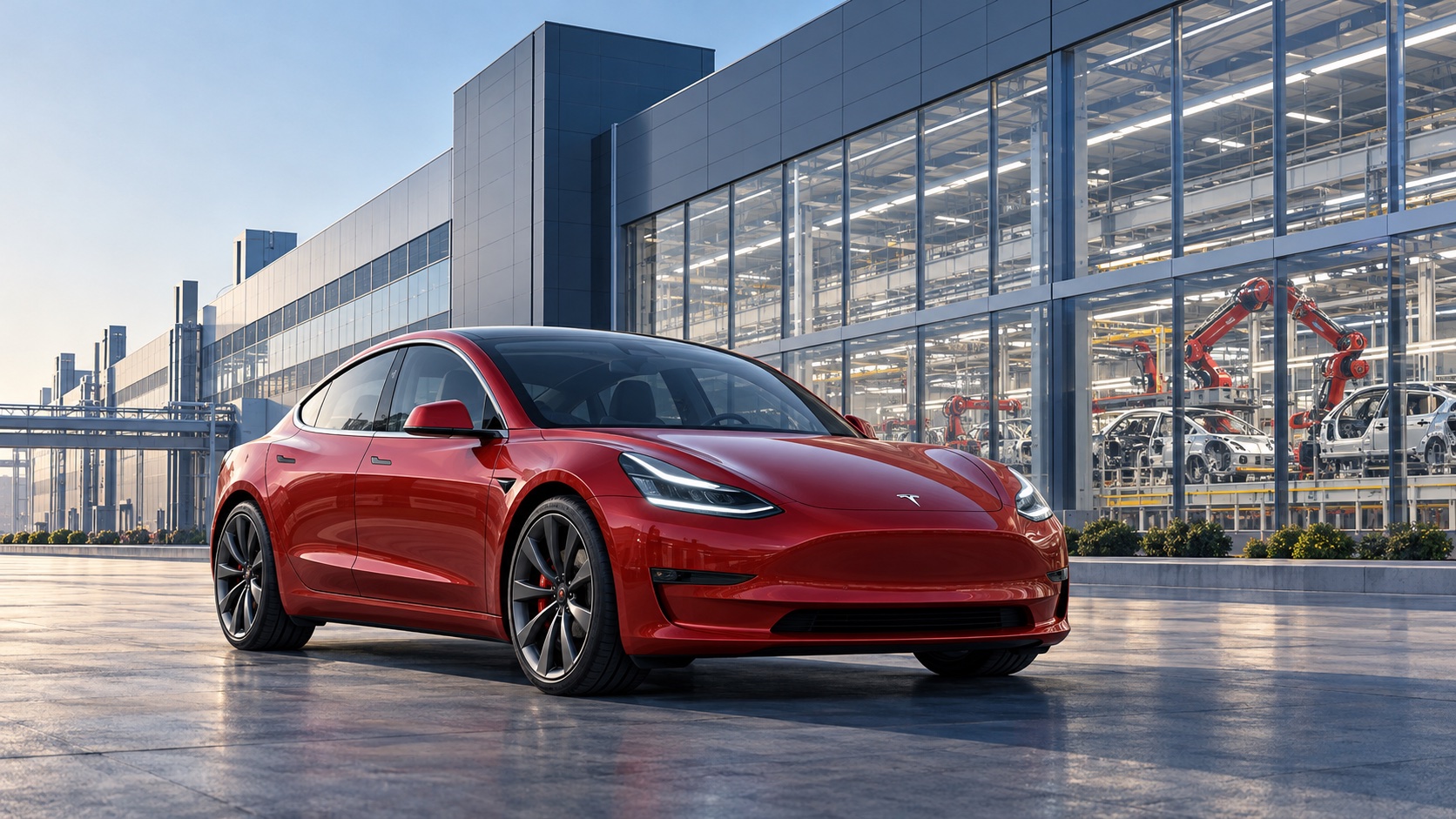
AI-generated illustration; not a documentary photograph. Tesla published its third-quarter results on 21 October 2026, covering July to September. These are not annual accounts: to assess its performance, we compare them with the same period in 2025 and, as a more recent reference, the previous quarter. Source: official announcement.
The latest results show a company improving its gross margin, but whose spending is growing too quickly for its flat revenue. Public policy plays a role, but does not explain the decline in profit on its own.
The numbers: stable revenue, lower profit
| Metric | Q3 2025 | Q2 2026 | Q3 2026 |
|---|---|---|---|
| Revenue | 28,095 | 28,236 | 28,046 |
| Gross profit | 5,054 | 4,751 | 5,494 |
| Operating expenses | 3,430 | 4,353 | 4,776 |
| Operating income | 1,624 | 398 | 718 |
| Net income attributable to common stockholders | 1,373 | 1,114 | 787 |
| Free cash flow | 3,990 | −1,092 | 1,531 |
USD millions. Source: Tesla’s results presentation.
Compared with 2025, revenue barely changed and net income fell approximately 43%. Gross profit, however, increased by $440 million.
The explanation lies further down the income statement: operating expenses rose by $1,346 million. The difference between these two changes accounts for the $906 million decline in operating income.
There is an operating recovery compared with the previous quarter, but not a return to the level of 2025. Source and our calculations based on the published results.
Public policy: a headwind, but also some one-off support
The end of the buyer incentive affects the comparison
The United States ended the federal tax credit for new vehicles acquired after 30 September 2025. The incentive could reach $7,500 when eligibility requirements were met. Source: IRS.
This matters for two reasons. First, a financial incentive to buy disappears. Second, the approaching deadline may have brought purchases forward into the 2025 quarter used as our benchmark.
But we should distinguish a mechanism from evidence: it is reasonable to consider this possible effect, not to attribute a specific number of lost sales to it without a verifiable estimate.
Lower regulatory credit revenue, but tariff refunds
Regulatory credit revenue fell 73% to $113 million. Tesla points to regulatory restrictions. These credits are not buyer incentives: they are a separate source of revenue.
On the positive side, tariff refunds reduced costs. Automotive gross margin increased from 17% to 18.5%, although the entire improvement should not be attributed to those refunds. Source: quarterly report.
It would therefore also be inaccurate to explain the quarter simply by saying that “tariffs hurt Tesla”.
Internal decisions weigh on profitability
R&D rose 69% to $2,761 million, driven by artificial intelligence, Optimus, chips, batteries and vehicle programmes, among other factors. Administrative expenses also increased, including stock-based compensation associated with the CEO’s award plan.
On the revenue side, FSD subscriptions helped; energy declined 16%, while services and other revenue grew 33%. The stable total conceals different underlying trends. Source: Tesla’s discussion of its results.
Spending on development is not necessarily a bad decision. It can build future businesses. But calling it an “investment in the future” is not enough to assume that it will be profitable: it must eventually generate sufficient earnings to compensate for the cost and risk.
Cash flow requires a balancing act
Tesla returned to positive free cash flow, but remained below the same quarter of 2025. Recovering from a negative quarter is not the same as demonstrating a sustained year-on-year improvement. Source: quarterly cash flow statements.
R&D and investment in facilities are also not interchangeable: the former generally affects expenses in the period; the latter uses cash and is typically recognised in the accounts over several years.
Conclusion: a stronger gross margin, but less of it reaches the bottom line
Our reading is that this quarter does not show a collapse in Tesla’s revenue or a broad deterioration in gross margins. It shows a mismatch between what its businesses generate and the rate at which its expense base is growing.
Regulatory changes reduce revenue, but do not explain that mismatch on their own. Part of it reflects Tesla’s own decisions: developing new products and technologies before they contribute sufficient results.
The recovery from the previous quarter is positive, but not yet enough to call it an established recovery. To demonstrate one, Tesla needs revenue to grow faster than expenses, or to contain those expenses without compromising its projects.
The diagnosis is not that betting on the future is a mistake. It is that those bets are reducing profitability today and have yet to prove that they will pay off.
Information available as of 2 November 2026. Business analysis, not investment advice.